Even if a development team adheres to the strictest standards for secure coding and maintains dependencies up to current, they could still ship software with a vulnerability. It’s as simple as that: real-world attacks are rarely based on a checklist. An attacker might combine an untrue authorization rule coupled with an exposed API endpoint, evade an automated process to reset passwords or realize that a user account is able to access another tenant’s data.
Companies that are located in Brisbane use professional penetration testing to guarantee security. They analyze systems through the adversarial lens. Instead of asking if security controls exist, experienced testers ask whether those controls can be easily bypassed.
The distinction is significant to Australian organisations that deal with sensitive assets such as healthcare records, financial data and customer information, among other assets that are considered to be sensitive.
Scanning through automated means only tells a small portion of the truth
Vulnerability scanners are useful. They can quickly spot outdated software, unsecure headers, well-known CVEs, and clear problem with the configuration. They cannot know how an application must behave.
Think about a portal for customers where users can change the account number inside a request and then retrieve a different invoices from a company. A scanner that is automated will not see anything abnormal if a server is sending perfectly valid responses. Human testers can identify the failure of authorization immediately.
Quality web penetration testing combines the automated process with manual analysis. Testers investigate authentication sessions, access control as well as injection risks API behavior, vulnerabilities in configuration as well as business processes seeking out combinations of weaknesses which could result in significant harm.
SaaS environments come with security concerns of their own
Multi-tenant cloud services require careful testing because one mistake can affect many customers simultaneously.
Saas penetration tests should cover tenant isolation and privilege functions. It should also include API authorization, change of role and account recovery, as well as data leakage, and integrations with external services. The tester needs to not just discern if a function is functioning, but also whether it can be modified in a way that the development team did not intend.
A user, for instance, given a role of a minimum level may not be able to see an administrative role in the interface. This doesn’t mean that the base API prevents them from calling it directly. It is essential to test the API rather than just looking at what appears.
Modern web applications offer an increased attack surface
Today’s applications often incorporate JavaScript front-ends and APIs cloud service providers Identity providers, microservices and other services. Any component, or the trust relationship between them, may have weaknesses.
Thorough web app penetration testing follows those connections. Testers can examine the way tokens and authorization are handled, whether sensitive servers adhere to the same guidelines, how data is moved between servers by users and also if a vulnerability appears to be low risk may be linked to another vulnerability that could lead to a significant attack.
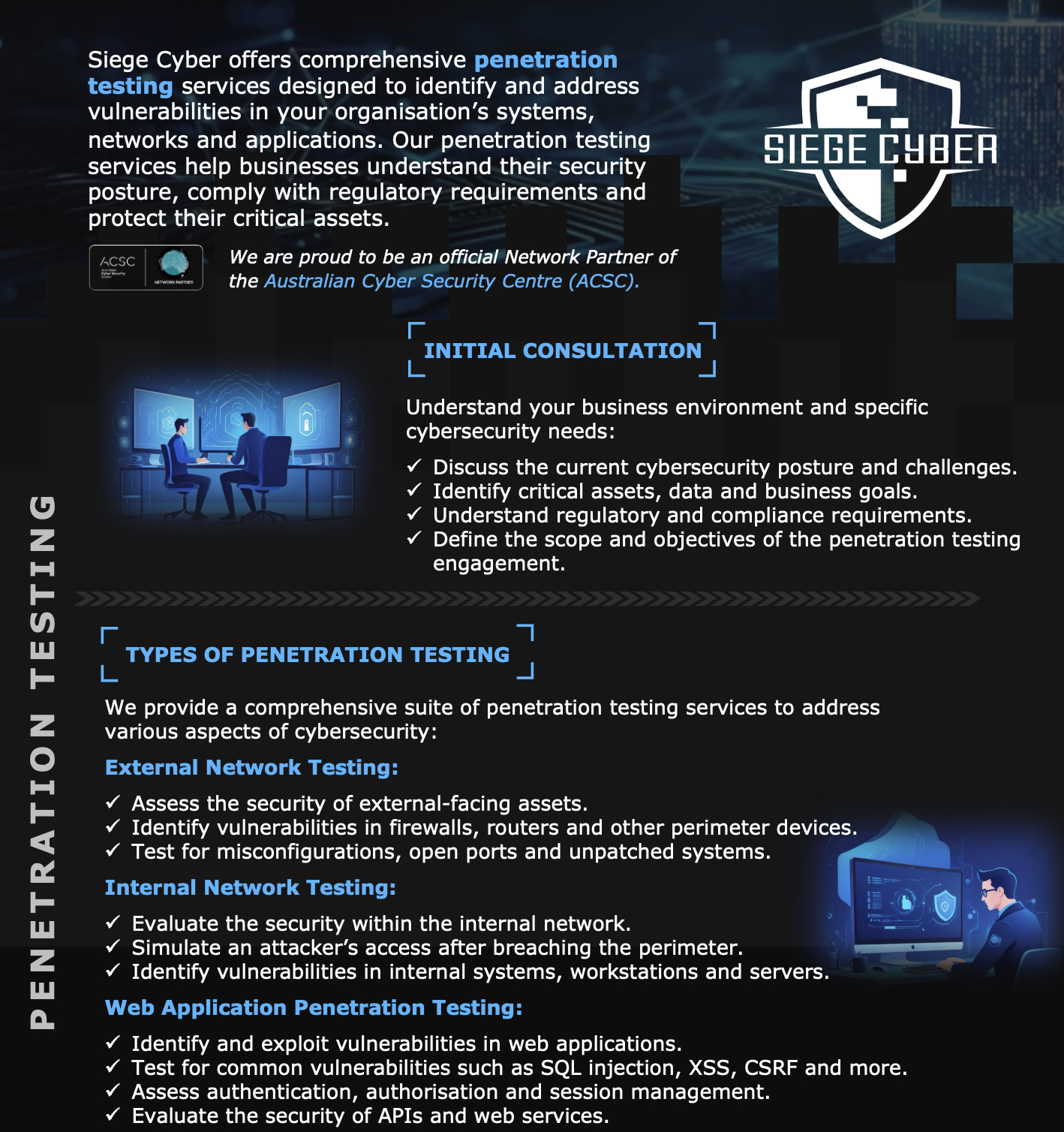
Siege Cyber is an expert in this type of testing applications. They are able to work with the latest frameworks like APIs and cloud-hosted platforms. They also test complicated application architectures.
The report will aid developers in resolving the issue
Finding vulnerabilities is only half of the job. Security testing offers the most benefit when the engineers can recreate the issue, understand the threat, and address it effectively.
Siege Cyber reports contain evidence reproducibility steps, as well as risks rating. They also contain assessments of the impact and practical advice on remediation and a thorough analysis of the impact. Technical teams are provided with the information necessary to correct the issue and business stakeholder get an executive-level overview of the risk. Important findings can also be addressed during the engagement rather than waiting for the report to be completed.
The retesting of the system after remediation adds an additional level of security to ensure that the issue was removed without the need for a new one.
Organizations seeking independent verification, proof of compliance, or increased confidence before a release could benefit by conducting penetration tests. It creates a safe environment to see how an attacker with skill might take on the system. It is important to find the answer before the adversary.